
I need to say something that will feel wrong to a certain kind of high-performer.
Table Of Content
Related Articles

I want to describe something that most senior professionals will not admit in public.
You don’t need another productivity hack. You need a clearer mind.
Doom scrolling isn’t just a bad habit it’s a sign of information overload that clouds judgment, drains energy, and weakens decision-making. Discover why true leadership begins by learning to filter signal from noise.
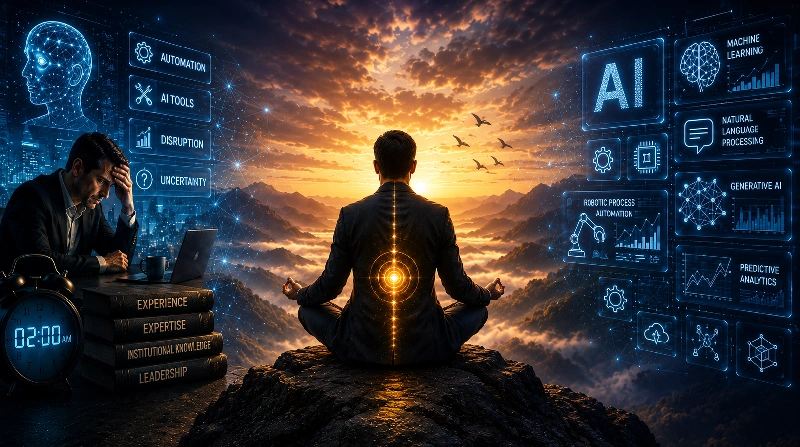
There is a specific kind of dread circulating among senior professionals right now.
AI Anxiety is real.
It’s not about losing your job it’s about questioning the value of everything you’ve spent decades building. The leaders who thrive won’t just master AI; they’ll master themselves.

The Future of Corporate Growth: Combining Business Strategy with Inner Transformation
The Future of Business: True corporate success is shifting away from mere strategy, capital, and technology. Instead, it will be driven by the quality of leadership and the depth of consciousness behind every major decision.

How Shaktipat Deeksha Supports Leadership, Relationships, and Productivity
Professional success is not driven by technical skills alone it begins with inner balance. When the mind is clear and emotions are stable, leadership strengthens, relationships flourish, and productivity reaches its full potential.
Your productivity system may be the thing blocking your highest performance.
Not the absence of a system.
The presence of one that has become a substitute for inner clarity.
Here is the pattern I am seeing:
A leader installs a new time-blocking method.
Improves output for three weeks.
Adds another layer — a weekly review, a daily scorecard.
Improves further.
Adds a no-meeting morning. A deep work protocol. A decision journal.
And somewhere in the fourth or fifth iteration of this, a subtle but significant shift occurs:
The system starts running the leader.
The leader starts serving the system.
And the question “what is the most important thing to do today?” — which should arise from intuition and wisdom — is now being answered by a colour-coded block on a calendar.
This is productivity addiction.
It is when the activity of optimising becomes a way of avoiding the deeper question:
What am I actually trying to build — and why?
The philosopher Blaise Pascal wrote in 1654: “All of humanity’s problems stem from man’s inability to sit quietly in a room alone.”
In 2026, the productivity industry has ensured that no one ever has to sit quietly in a room alone ever again.
There is always a framework. A template. A reflection prompt.
Something between you and the silence.
Because in the silence, the real questions arise.
And the real questions are less comfortable than a well-filled Notion page.
In yogic science, the Ajna Chakra — the Third Eye — is the seat of what the Vedas call Viveka: the faculty of discrimination, the ability to instantly sense what is truly important from what merely appears so.
When Viveka is functioning:
Priorities are obvious.
Time is used instinctively, not architecturally.
The most important work happens not because it was scheduled, but because it could not wait.
Most productivity systems are designed to compensate for low Viveka — not to develop it.
Shaktipat energy transmission, guided by Sadguru Narendra Satyanand, activates the Ajna Chakra directly.
The result is not a better system.
It is a leader who no longer needs one to know what matters.
The Distinction